
In today’s competitive online ecosystem, having a piecemeal digital marketing approach is rarely sufficient. Brands and businesses need a digital marketing roadmap: a strategic, phased plan that guides efforts from foundational setup through growth, optimization, and scaling. A roadmap helps you prioritize, allocate resources, and measure progress over time.
This blog will walk you through a comprehensive digital marketing roadmap — covering the stages, key deliverables, tactics, metrics, and pitfalls to watch out for. You can use this as a blueprint for your own business or client.
1. Why You Need a Digital Mrketing Roadmap

-
Clarity & Focus: A roadmap gives direction—what to do first, next, and later—so your efforts are coherent, not scattered.
-
Resource Allocation: Helps you invest budgets, time, and personnel more intelligently.
-
Milestones & Accountability: You can track progress at each step, evaluate success or failure, adjust.
-
Avoiding “Shiny Object Syndrome”: Many marketers chase trends or channels without integrating them into a bigger picture; a roadmap helps you avoid that.
-
Scalability: It provides a repeatable framework you can adapt or replicate across campaigns, products, or markets.
2. Phases of the Digital Mtketing Roadmap

A good roadmap proceeds in phases. Here’s a recommended structure:
2.1 Phase 1: Foundation & Audit
Goal: Understand where you stand, fix gaps, set up key infrastructure.
Key Activities & Deliverables:
-
-
Review your brand identity, messaging, value propositions, positioning.
-
Audit your competitors: their channels, content, engagement, strengths, weaknesses.
-
Audience research: who are your ideal customers, their pain points, behavior, content preferences.
-
-
Website / Digital Asset Audit:
-
Evaluate your website: UX, speed, mobile responsiveness, navigation, content structure.
-
On‑page SEO audit: meta tags, headings, internal linking, duplicate content.
-
Analytics / tracking audit: ensure Google Analytics (or equivalent), conversion tracking, events, data accuracy.
-
Technical audit: site errors, broken links, security (SSL), canonicalization, schema markup.
-
-
Channel & Content Audit:
-
Review existing content (blogs, videos, social media, email) for performance and gaps.
-
Assess social presence, follower growth, engagement.
-
Evaluate past campaigns (paid, organic) and their ROI.
-
-
Set Baseline Metrics & KPIs:
-
Document current performance (traffic, conversions, bounce rate, etc.).
-
Decide on key performance indicators (KPIs) for going forward.
-
-
Fix Critical Gaps:
-
Install or fix tracking (analytics, tag managers, event capture).
-
Resolve website usability or technical issues that block performance.
-
Establish brand guidelines (tone, visual identity).
-
At the end of Phase 1, you should have a clean baseline, insight into strengths & weaknesses, and a foundation you can build on.
2.2 Phase 2: Strategy & Planning
Goal: Define goals, channel mix, content plan, and campaign architecture.
Key Activities & Deliverables:
-
Define Strategic Objectives:
-
What are your goals? E.g. awareness, leads, sales, retention.
-
For each, define measurable targets (e.g. “Increase monthly leads by 50% in 6 months”).
-
-
Audience & Persona Development:
-
Create buyer personas (demographics, psychographics, pain points, decision journey).
-
Map customer journeys: from awareness → evaluation → purchase → loyalty.
-
-
Channel & Tactic Mix:
-
Decide which channels to use and when (e.g. SEO, content marketing, social media, paid ads, email, influencer).
-
Allocate initial budget / resources across channels.
-
-
Content Strategy & Calendar:
-
Decide on content themes, formats, pillars (blog posts, infographics, video, webinars, ebooks).
-
Create an editorial calendar mapping topics, publishing cadence, content promotion plans.
-
Plan content upgrades, lead magnets, gated assets.
-
-
Campaign & Funnel Architecture:
-
Design marketing funnels (top, middle, bottom).
-
Map campaigns for each funnel stage.
-
Decide offers: lead magnets, tripwires, core offers, upsells.
-
-
Budgeting & Resource Planning:
-
Set budgets per channel, per campaign phase.
-
Assign roles: content creators, designers, PPC, analysts.
-
Timeline estimates, dependencies.
-
-
Measurement & Attribution Model:
-
Choose attribution model (first touch, last touch, multi-touch).
-
Define tracking points, dashboards, reporting cadence.
-
By the end of Phase 2, you have a clear strategy, blueprint, and plan to act on.
2.3 Phase 3: Execution & Launch
Goal: Launch your channel efforts, implement campaigns, and begin generating results.
Key Activities & Deliverables:
-
Content Production:
-
Write blog posts, design visuals, record videos, produce lead magnets.
-
Optimize for SEO, readability, shareability.
-
-
Channel Setup & Launch:
-
SEO: publish on‑page content, optimize meta tags, internal links.
-
Paid Ads: build ad accounts, campaigns, ad sets, creatives, targeting.
-
Social Media: set up profiles, content schedules, posting, community management.
-
Email Marketing: set up email platform, flows (welcome series, nurture), list building.
-
Influencer / Partnerships: outreach, collaborations, content co-creation.
-
-
Landing Pages & Funnels:
-
Build high-converting landing pages aligned with ads and offers.
-
Setup lead capture forms, thank you pages, email triggers.
-
A/B test headlines, CTAs, layouts.
-
-
Tracking & QA:
-
Test all tracking (UTMs, conversion pixels, analytics) end-to-end.
-
Quality check creatives, pages, grammar, mobile responsiveness.
-
Testing across browsers, devices.
-
-
Soft Launch / Pilot Campaigns:
-
Run small budget test campaigns to validate messaging, targeting, funnels.
-
Monitor early performance and identify immediate tweaks.
-
Launch is not the finish line — it’s the beginning of feedback loops.
-
-
2.4 Phase 4: Growth & Optimization
Goal: Improve performance, refine channels, maximize ROI using your digital marketing roadmap.
Key Activities & Deliverables:
Performance Monitoring & Reporting:
Daily / weekly reviews of KPIs — traffic, CTRs, conversion rates, cost per lead/sale — according to your digital marketing roadmap.
Use dashboards for visibility by channel, campaign, ad set, ensuring alignment with the digital marketing roadmap.Testing & Iteration:
A/B test creatives, headlines, offers, and landing pages as outlined in your digital marketing roadmap.
Test audience variations and new segments. Rotate content formats based on your digital marketing roadmap insights.Audience Refinement:
Prune underperforming audiences. Expand lookalikes or higher-tier segments. Exclude converters or irrelevant segments in line with the digital marketing roadmap.Budget Reallocation:
Shift spend to highest-performing channels & campaigns. Cut wasted spend. Scale up winners gradually, following the digital marketing roadmap.SEO / Content Growth:
Update older posts, add internal links, improve SEO. Repurpose content into new formats (video, infographics, social posts). Promote content via outreach, guest posts, collaborations guided by the digital marketing roadmap.Email / CRM Optimization:
Optimize automated flows (e.g., nurture sequences), segment lists for personalization, and test subject lines, email content, and send timing as planned in your digital marketing roadmap.Retention & Upsell Tactics:
Launch post-sale campaigns: upsells, cross-sells, loyalty programs. Run re-engagement campaigns for inactive users, using feedback from the digital marketing roadmap.Advanced Tactics Experimentation:
Try new formats: interactive content, quizzes, AR, chatbots. Run small experiments for emerging channels (podcasts, new social platforms). Conduct incremental lift/holdout tests according to the digital marketing roadmap.
2.5 Phase 5: Scaling & Expansion
Goal: Grow aggressively but sustainably, expand reach, and maintain ROI guided by the digital marketing roadmap.
Key Activities & Deliverables:
Horizontal Scaling:
Move into new geographies/markets. Expand to new audience segments, verticals. Clone winning funnels or campaigns with tweaks based on your digital marketing roadmap.Vertical Scaling:
Increase budget on top-performing campaigns. Broaden targeting gradually. Add more ad sets or creative variations, following the digital marketing roadmap.Channel Diversification:
Introduce new channels (display, native, affiliate, video platforms). Develop brand partnerships, co-marketing, and leverage PR or offline promotions guided by the digital marketing roadmap.Automation & Process Optimization:
Automate reporting, bidding rules, and budget shifting. Use AI/machine learning tools for creative generation and insights, per your digital marketing roadmap. Document processes, build templates, and standardize workflows.Brand Building & Authority:
Invest in thought leadership, speaking, webinars, and long-form content. Strengthen brand equity so customers trust you beyond just offers, following the digital marketing roadmap.Sustainability & Maintenance:
Monitor performance decline risks (creative fatigue, shifting trends). Refresh content and campaigns periodically. Stay updated with algorithm/policy changes using the digital marketing roadmap.Long-Term Measurement & Attribution:
Conduct incrementality experiments to attribute growth properly. Evaluate lifetime customer value (LTV) and optimize toward that. Build forecasts and scale models in alignment with your digital marketing roadmap.
-
By this phase, you should have a robust, scalable ecosystem of channels, funnels, content, and measurement.
3. Key Channels & Tactics in Each Phase
Here’s how common digital marketing channels map across the phases:
| Channel / Tactic | Foundation / Audit | Strategy / Planning | Execution / Launch | Growth & Optimization | Scaling / Expansion |
|---|---|---|---|---|---|
| SEO / Organic Search | Audit site, keywords | Keyword strategy, content plan | Publish optimized content | Update/refresh, internal linking, promotion | Expand to more keyword clusters, new languages |
| Content Marketing / Blogging | Audit existing content | Pillars, calendar, formats | Publish, promote, guest (if applicable) | Iterate, repurpose, SEO optimize | Launch content hubs, affiliations, syndication |
| Social Media | Audit presence & engagement | Platform selection, tone, calendar | Launch posting, community building | Boost high-performers, test formats | New platforms, influencer expansion, paid social |
| Paid Ads (PPC, Social Ads) | Audit past campaigns, tracking | Channel mix, funnel planning, budget | Launch campaigns, creatives, targeting | Test & optimize audiences, creatives, budgets | Scale winners, new geos, ad formats |
| Email / CRM | Audit list, flows | Lead magnets, segmentation, flow mapping | Build flows, capture, nurture | Segment, optimize open/click rates, flows | Advanced automation, personalization, AI |
| Partnerships / Influencer | Audit past collabs | Identify relevant partners, terms | Launch pilot partnerships | Evaluate & scale high-performing partnerships | Co-branded campaigns, ambassador programs |
| Analytics & Data | Audit setup, data hygiene | Dashboard, attribution model | Track events, conversions | Deep dive attribution, funnel analysis | Incrementality tests, predictive modeling |
You don’t need to launch all channels immediately — start with your core channels (often content + paid + SEO) and expand over time.
4. Metrics & KPIs to Track
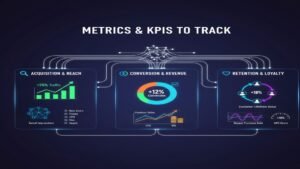
Your roadmap should be tightly tied to metrics. Below are essential KPIs by phase and channel.
Foundation & Audit Phase
-
Website traffic baseline (sessions, users)
-
Bounce rate, average session duration
-
Conversion rate (current)
-
Technical SEO health (site errors, crawlability)
-
Engagement metrics (social, email)
-
Baseline revenue, lead volume, acquisition cost
Execution & Launch Phase
-
Impressions / reach
-
Click-through rate (CTR)
-
Cost per click (CPC)
-
Landing page conversion rate
-
Cost per lead / acquisition
-
Lead-to-customer ratio
-
Email open & click rates
-
Engagement / social metrics
Growth & Optimization Phase
-
Return on ad spend (ROAS)
-
Customer acquisition cost (CAC)
-
Lifetime value (LTV)
-
Incremental lift (via holdout tests)
-
Traffic growth by channel
-
Content performance (shares, backlinks)
-
Email revenue per subscriber
Scaling & Expansion Phase
-
Margins & profitability (net ROI)
-
Channel diversification metrics
-
Scalability (e.g. how much incremental spend retains ROI)
-
Market penetration metrics
-
Automation efficiency (time savings, error reduction)
At every phase, set both leading metrics (which predict future performance) and lagging metrics (which measure outcomes).
5. Tools & Tech Stack Recommendations

A strong tech stack supports the roadmap. Here are categories and suggestions:
| Function | Tools / Platforms |
|---|---|
| Analytics & Tracking | Google Analytics 4, Google Tag Manager, Facebook Pixel / Conversions API, Mixpanel |
| SEO / Keyword & Site Audit | Ahrefs, SEMrush, Screaming Frog, Moz |
| Content / Blogging | WordPress, Contentful, Ghost |
| Email / Marketing Automation | Mailchimp, ActiveCampaign, Klaviyo, Sendinblue |
| Paid Ads | Google Ads, Facebook Ads Manager, Microsoft Ads, LinkedIn Ads |
| Landing Pages / Funnels | Unbounce, Leadpages, ClickFunnels, Elementor, Webflow |
| Social Media Management | Buffer, Hootsuite, Sprout Social, Later |
| Design / Creative | Canva, Adobe Creative Cloud (Photoshop, Illustrator), Figma, Adobe Premiere |
| A/B Testing & CRO | Optimizely, VWO, Google Optimize |
| CRM / Sales Tools | HubSpot, Salesforce, Pipedrive, Zoho CRM |
| Automation & Integrations | Zapier, Integromat (Make), n8n |
| Collaboration & Project Management | Asana, Trello, Notion, Monday.com |
As you scale, you may add specialized tools (e.g. advanced BI dashboards, AI content tools, predictive analytics) to support efficiency and insights.
6. Common Challenges & Mitigation

No digital marketing roadmap is without obstacles. Here are challenges you might face and how to mitigate them:
-
Limited budget or resources
→ Prioritize high-impact channels, run small tests, reinvest gains. -
Slow results, impatience
→ Set realistic expectations, focus on long term metrics like LTV, not instant wins. -
Data tracking issues / attribution mismatch
→ Audit thoroughly, test end-to-end flows, use first-party data when possible. -
Creative fatigue / content burnout
→ Batch content production, repurpose, rotate themes, plan ahead. -
Channel underperformance
→ Be ready to cut or pause channels; don’t throw more money in hoping it works. -
Scaling collapse (performance drops when budget increases)
→ Scale gradually, clone rather than doubling, monitor metrics. -
Shifting platform / algorithm changes
→ Stay updated, allocate a portion of budget to experiments, diversify channels. -
Overwhelm / misalignment across team
→ Maintain clear ownership, documentation, weekly check-ins, and progress reviews.
7. Sample 12‑Month Timeline

Here’s a hypothetical 12‑month roadmap outline for a medium business that wants to build digital growth.
| Month | Focus / Milestones | Key Deliverables |
|---|---|---|
| 1 | Foundation & Audit | Complete audits, fix tracking & site issues, baseline metrics |
| 2 | Strategy & Planning | Personas, content strategy, channel plan, funnel design |
| 3 | Execution Launch | Launch core content, set up ad accounts, run pilot campaigns |
| 4 | Optimization | Begin A/B tests, audience refinement, content updates |
| 5 | Scaling Light | Increase budgets gradually, test new creatives, extend reach |
| 6 | Channel Expansion | Roll out new channels (e.g. email, influencer, display) |
| 7 | Data Deep Dive | Attribution modeling, incrementality testing, refine funnels |
| 8 | Automation Starts | Automate reports, email flows, bidding rules |
| 9 | Geographic / Audience Expansion | Enter new markets or segments, clone campaigns |
| 10 | Brand & Authority Push | Thought leadership content, webinars, PR, stronger branding |
| 11 | Sustainability | Refresh creatives, prune weak campaigns, maintain performance |
| 12 | Evaluation & Strategy Refresh | Review year, plan next 12 months, set new goals |
Adjust pacing depending on your team size, budget, industry, and results along the way.
8. Conclusion & Next Steps
A digital marketing roadmap is more than a to‑do list — it’s a strategic guide that aligns your activities, investments, and measurement across time. A well-structured digital marketing roadmap ensures every campaign, channel, and tactic contributes to your overarching business goals. By following the phases of your digital marketing roadmap — from auditing and strategy to launch, optimization, and scaling — you build a resilient growth engine rather than relying on ad hoc tactics. Regularly reviewing and updating your digital marketing roadmap allows you to adapt to market shifts, track KPIs, and refine strategies. Ultimately, a comprehensive digital marketing roadmap turns planning into measurable results and long-term business success.
Suggested Next Steps for You:
-
Customize this roadmap: Adapt the phases, channels, and timings to your business model, audience, and industry.
-
Run your Phase 1 audit: Use this as the first milestone — understand where you are now.
-
Set 3–5 “North Star” metrics: Decide what success looks like in 6–12 months.
-
Start with a core channel set: Don’t overextend; excel first in one or two channels.
- Review quarterly: Roadmaps should evolve — re-evaluate and adjust every 3 month
Ather : irfan