
In the digital marketing landscape, Facebook remains one of the most powerful advertising platforms. With its deep user data, advanced targeting, and ongoing innovations (such as AI, automation, and creative tools), a strong Facebook advertising strategy allows brands of all sizes to reach prospects, nurture them, and drive conversions effectively. However, running Facebook Ads successfully requires more than just launching campaigns—it demands a well-planned Facebook advertising strategy, continuous optimization, and consistent creative testing.
In this comprehensive guide, we’ll walk through a complete Facebook advertising strategy, covering everything from campaign foundations, audience and creative planning, to setup, optimization, and scaling. Avoiding common pitfalls and accurately measuring performance are key components of any successful Facebook advertising strategy. By applying these best practices, marketers can improve results over time, making their overall Facebook advertising strategy more efficient and impactful.
1. Why Facebook Advertising Strategy Still Matters
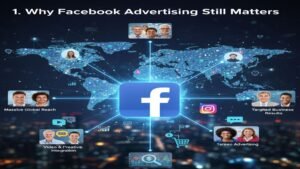
1.1 Massive Reach & User Engagement
-
Facebook still commands billions of active users daily, making it a place your customers are likely to spend time.
-
People use Facebook not just for connecting, but for exploring content, products, and ideas — so ads can meet users in discovery mode.
-
Because organic reach has declined over time (especially for business pages), paid is often necessary to reach a meaningful audience.
1.2 Sophisticated Targeting
-
Facebook (Meta) offers demographic, interest, behavioral, and psychographic targeting, allowing advertisers to zero in on highly specific audiences.
-
You can also layer targeting (e.g. “women, 25–40, interested in fitness and nutrition, in a 10 km radius of city X”).
1.3 Retargeting & Custom Audiences
-
The Facebook Pixel, app events, offline conversions, and integrations allow advertisers to retarget people who have already shown interest (visited site, added to cart, engaged with content).
-
This ability to reconnect with “warm” audiences significantly boosts return on ad spend (ROAS).
1.4 Lookalike Audiences
-
Facebook’s Lookalike Audiences let you expand your reach by finding new people who behave similarly to your best customers. Wikipedia
-
This offers a powerful way to scale while maintaining audience quality.
1.5 Flexibility in Ad Formats & Creativity
-
You can run single image ads, video ads, carousels, collections, slideshows, dynamic product ads, lead ads, and more.
-
The variety allows tailoring creative to the message, funnel stage, and user preference.
1.6 Automation, AI & Optimization Tools
-
Facebook provides automated rules, campaign budget optimization (CBO), dynamic creative, A/B testing, and AI-assisted creative generation.
-
Meta is even working toward automating entire ad creation workflows using AI. Reuters+1
Given these strengths, Facebook remains a core channel in many brands’ digital strategies. The difference lies in how well you execute.
2. Key Challenges & Pitfalls (What to Watch Out For)

Before you dive in, it’s important to be aware of common pitfalls so you can avoid them:
2.1 Poor Audience Research
If your targeting is too broad or not well-aligned with your buyer personas, ad spend can be wasted showing to unqualified people.
2.2 Weak Creative / Messaging
Even with great targeting, ads fail if the visuals, copy, or offer don’t resonate. Many accounts underperform because creative becomes stale or irrelevant.
2.3 Overlooking the Funnel
If all your ads are focused solely on “buy now,” you miss the opportunity to nurture prospects through awareness and consideration phases.
2.4 Ignoring Testing & Learning
Running ads without systematically testing (creative, audiences, offers) leads to stagnation. Split testing is fundamental. Tinuiti+2AdEspresso+2
2.5 Bad Tracking / Attribution Setup
If your Facebook Pixel, conversions API, or analytics setup is flawed, you won’t know what’s working (or not). Incorrect attribution leads to misinformed decisions.
2.6 Scaling Too Fast
Some advertisers pour more budget prematurely into winning ad sets, causing performance to crash or become inefficient.
2.7 Ad Fatigue
Running the same creative repeatedly leads to audience fatigue and declining CTRs. Rotate creative regularly.
2.8 Account Issues & Policy Violations
Violating Facebook’s ad policies (intellectual property, prohibited content, misleading claims) can lead to disapprovals or account suspension.
3. Defining Objectives & Where to Start

Your strategy must begin with clarity of objective. What do you want to achieve?
Here are typical objectives and use‑cases:
| Objective | Use Case / Stage | Metrics to Focus On |
|---|---|---|
| Awareness / Reach / Brand Lift | New product launch, expanding audience | Reach, impressions, CPM, brand lift surveys |
| Traffic / Engagement | Drive visits to blog, content consumption | Link clicks, CTR, time on site, engagement |
| Lead Generation / Consideration | Capture email leads, form submissions | Cost per lead (CPL), quality of leads |
| Conversions / Sales | E‑commerce purchases, signups | ROAS, cost per acquisition (CPA), revenue |
| Catalog / Product Sales | Promoting many products dynamically | ROAS, purchase volume |
| App Installs / App Events | Driving app downloads / usage | Install rate, in‑app purchases, retention |
| Store Traffic / Offline Conversions | Physical store visits, calls | Offline conversions, store visits |
3.1 Start with One or Two Objectives
If you are new to Facebook Ads, start with one clear objective (e.g. traffic or conversions) rather than trying to tackle all funnel stages at once.
3.2 Define Success Metrics & Benchmarks
Decide in advance what metrics matter (e.g. cost per acquisition, ROAS, return on ad spend). Set benchmarks based on industry, your historical data, or competitor research.
3.3 Map the Customer Journey
Sketch how a user will move from seeing the ad → interacting → eventually converting. This helps you choose which creative, messaging, and offers to run at each stage.
4. Audience Strategy
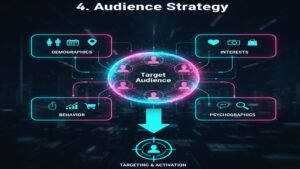
Audience is the backbone of Facebook ads.
-
4.1 Broad vs Narrow Targeting
Broad targeting gives Facebook more room to optimize and find converting users—but may waste spend initially. Narrow or layered targeting reduces waste but may limit reach and scaling potential. A hybrid approach is often best (start broad, then refine). Choosing the right balance is a key part of any Facebook advertising strategy.
4.2 Saved / Core Audiences
You can build audiences based on demographics, interests, behaviors, location, and more. Use audience insights (from your page, analytics) to guide selection. Leveraging saved and core audiences effectively strengthens your Facebook advertising strategy.
4.3 Custom Audiences (Warm / Existing Users)
-
Website visitors (via Facebook Pixel)
-
People who engaged with your content (videos, page, posts)
-
Email lists, phone lists, mobile app users
-
Offline/CRM data
Retargeting these users often yields higher conversion rates. Incorporating custom audiences is a cornerstone of a strong Facebook advertising strategy.
4.4 Lookalike Audiences
Once you have a seed audience (e.g., purchasers, email subscribers), you can build lookalike audiences—users who resemble your seed in behavior and interests. A few pointers:
-
Start small (1% lookalike) before expanding to 2–3%
-
Use multiple lookalikes (e.g., top purchasers, frequent customers) to test which performs better
-
Combine with exclusion audiences (exclude existing customers) to avoid overlap
Leveraging lookalike audiences strategically is a proven tactic in a scalable Facebook advertising strategy.
4.5 Exclusion Audiences
Always exclude irrelevant or already converted users in each campaign (e.g., exclude purchasers from a conversion campaign). This avoids wasted spend and ad overlap. Proper use of exclusion audiences ensures efficiency in your Facebook advertising strategy.
4.6 Audience Layering & Intersection
You can layer targeting (e.g., interest + demographic) or use audience intersection (people who satisfy both criteria) to further refine. Be cautious not to overconstrain and reduce reach too drastically.
4.7 Audience Size and Scaling
-
Custom audiences should be at least a few thousand for good performance.
-
If an audience is too small, you’ll run out of reach or get high frequency/fatigue.
-
Gradually expand targeting over time (wider interest categories, broader locations).
-
5. Creative Strategy: Visuals, Copy & Formats
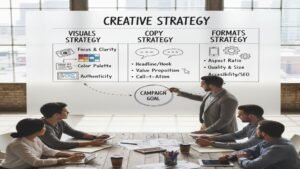
Your ad creative and messaging can make or break performance. Even with perfect targeting, weak creative leads to failure.
5.1 Choosing the Right Format
-
Single image ads: Simple, effective. Use for direct messages, offers.
-
Video ads: Highly engaging. Use for storytelling, demonstrating benefits, or capturing attention.
-
Carousel / Collection / Catalog ads: Great when you have multiple products or features to show. AdvertiseMint
-
Dynamic ads: Automatically show users the product(s) they viewed or are likely to like.
-
Lead ads: Built-in Facebook forms (mobile‑friendly) for capturing leads directly.
-
Slideshow / instant experience: Lightweight video-like experience for lower bandwidth.
-
Reels / short video formats (on Facebook & Instagram): Short, snackable, immersive. Use strong hooks.
5.2 Visual Best Practices
-
Use high-resolution images or video footage.
-
Use bright colors, contrast, and clean layouts.
-
Avoid too much text overlay (Facebook penalizes text-heavy images).
-
Use visuals that reflect your audience, context, and product in realistic settings.
-
Use multiple creatives and rotate them to avoid fatigue.
5.3 Copy & Messaging
-
Use a strong hook: lead with benefit, curiosity, or problem to catch attention quickly.
-
Keep it concise. Social media users scroll fast.
-
Use a clear call to action (CTA). (“Shop Now,” “Learn More,” “Get Offer,” etc.)
-
Use urgency or scarcity when appropriate (limited time, limited stock) but avoid overuse.
-
Leverage social proof (reviews, user testimonies) when possible.
-
Test emotional vs rational messaging (e.g. pain points, aspirations).
-
Use dynamic text or personalization if possible.
5.4 Tailoring Creative by Funnel Stage
-
Awareness: Focus on brand, value proposition, problem identification.
-
Consideration: Educate, compare alternatives, present differentiation.
-
Conversion: Push for action—offer, discount, guarantee, strong CTA.
-
Retention / Upsell: Cross-sell, loyalty incentives, subscription offers.
5.5 Creative Testing (Variants & Combinations)
-
Always test multiple creative variations (images, videos, copy, headlines) to find what resonates.
-
Change only one variable at a time per test (so you can attribute impact).
-
Use Facebook’s dynamic creative option to automatically combine creatives and test combinations.
6. Budgeting & Bidding Strategy

-
6.1 How Much to Spend?
There’s no one-size-fits-all. Start with a modest test budget that you can afford to learn from. Many advertisers allocate 10–20% of projected revenue (or margin) to paid acquisition. Be ready to scale or cut based on performance. Proper budgeting is a critical part of any effective Facebook advertising strategy.
6.2 Budget Types
-
Campaign Budget Optimization (CBO): Facebook allocates budget across ad sets inside a campaign to maximize performance.
-
Ad Set Budget: You control budget per ad set.
Choose one approach (CBO or ad set budgeting), but don’t mix them in the same campaign. Choosing the right budget type is an essential component of a smart Facebook advertising strategy.
6.3 Bidding Strategies
-
Lowest cost (auto bid): Let Facebook optimize for lowest cost given your objective.
-
Cost cap: You set a maximum cost you’re willing to pay per result.
-
Bid cap / target cost: You set a fixed bid limit or target.
The bidding strategy should match your objective and your comfort level with risk. For new accounts, auto/lowest cost is often safer. Aligning your bidding with goals is a key tactic in any Facebook advertising strategy.
6.4 Pacing & Spend Control
-
Use daily budgets to control spend.
-
Use lifetime budgets when running for a fixed period (e.g., promotional events).
-
Use automated rules to pause underperforming ad sets or scale winning ones.
Managing pacing effectively ensures efficiency and return on investment in your Facebook advertising strategy.
6.5 Spend Ramp-Up Strategy
When scaling, increase budgets gradually (~10–30% per step) rather than doubling overnight. Monitor key metrics (CPA, ROAS, CTR) closely during scaling. Be wary of sudden performance drops when performance “breaks” upon scaling. A careful ramp-up plan is crucial for sustainable growth in a well-executed Facebook advertising strategy.
-
7. Campaign Structure & Funnel Design
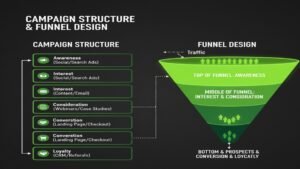
A thoughtful structure helps you manage and optimize campaigns effectively.
7.1 Layered Funnel Strategy
-
Top of Funnel (TOF) / Awareness / Prospecting
-
Reach new audiences
-
Light-touch messaging, brand introduction
-
Use broader targeting + lookalikes
-
-
Middle of Funnel (MOF) / Engagement / Consideration
-
Target users who engaged (clicked, viewed, watched video, visited website)
-
Messaging more product- or value-focused
-
Use retargeting, video custom audiences, content offers
-
-
Bottom of Funnel (BOF) / Conversion
-
Target warm audiences who visited product pages, added to cart
-
Use offers, discounts, urgency
-
Focus on driving purchase actions
-
-
Retention / Upsell / Loyalty
-
Target existing customers (past purchasers)
-
Promote related products, upgrades, subscriptions
-
This layered funnel allows you to nurture users across the journey, rather than expecting a first-touch ad to convert immediately.
7.2 Campaign & Ad Set Segmentation
-
By objective / funnel stage: Use separate campaigns for TOF, MOF, BOF.
-
By audience type: Use different campaigns or ad sets for distinct target segments (e.g. men vs women, location clusters).
-
By creative themes / offers: Test creative angles in separate ad sets.
-
By product vertical (if applicable): If you have multiple product categories, separate them.
This segmentation ensures clearer insights and avoid cross-interference or budget cannibalization.
7.3 Attribution & Conversion Windows
-
Choose appropriate conversion windows (e.g. 7-day click, 1-day view) based on your sales cycle.
-
Be aware that Facebook’s attribution models may differ from your analytics tools; align expectations.
7.4 Campaign Timing & Seasonal Planning
-
Account for seasonality (holidays, festivals, sales events).
-
Build awareness campaigns ahead of major launch periods.
-
Plan budget spikes around key dates.
8. Testing & Optimization

Optimization is continuous. The best campaigns evolve.
-
8.1 A/B / Split Testing
Test one variable at a time (e.g., image, headline, CTA). Use Facebook’s built-in split test tool for control. Track performance versus control and kill underperformers. Systematic testing is a cornerstone of any effective Facebook advertising strategy.
8.2 Creative Refresh & Rotation
Rotate or refresh creatives every 7–14 days (depending on spend & reach) to combat ad fatigue. Keep a creative calendar to plan new visuals, copy, and formats. Regular creative refresh ensures your Facebook advertising strategy stays relevant and engaging.
8.3 Audience Pruning & Expansion
Exclude underperforming segments or audiences. Expand audience reach gradually. Test new lookalikes or interest buckets. Proper audience management is a key component of a winning Facebook advertising strategy.
8.4 Adjust Bid Strategy / Budget
Monitor CPA, ROAS, CTR, and relevance score (or quality ranking). Use automated rules (e.g., pause ad sets above cost thresholds). Shift budget toward best-performing ad sets. Smart budget and bid adjustments help maximize ROI in your Facebook advertising strategy.
8.5 Analyze Funnels & Drop-off Points
Use Facebook Analytics, Google Analytics, or other attribution tools to see where users drop out. Improve landing pages, reduce friction, and optimize checkout flow. Check load times, mobile experience, and clarity of messaging. Funnel analysis is critical for optimizing any robust Facebook advertising strategy.
8.6 Use AI / Automated Tools
Use tools such as dynamic creative and automated rules to optimize at scale. Facebook’s AI text generation (like AdLlama) has shown improvements in CTR (~6.7% uplift) in large-scale testing.
8.7 Monitor “Ad Delivery Skew” Risks
Facebook’s delivery algorithms may favor certain segments (skewing delivery), even if your targeting is balanced. Watch whether certain demographics dominate impressions or conversions and adjust if needed.
9. Scaling Strategies

Once you achieve a stable, profitable setup, the next phase is scaling efficiently.
9.1 Vertical Scaling (Increasing Budget)
-
Gradually increase budgets in winning campaigns (10–20% steps).
-
Monitor key metrics; if performance degrades, pause and revisit structure, creative, audiences.
9.2 Horizontal Scaling (Expanding Channels / Audiences)
-
Clone winning campaigns with slight audience variations or new lookalikes.
-
Test new geographic markets.
-
Introduce new creatives or angles to reach fresh audience subsets.
9.3 Funnel Expansion
-
Expand middle-funnel and top-funnel campaigns to feed more users into bottom-funnel conversion.
-
Increase investment in MOF and BOF once TOF is generating consistent traffic.
9.4 Diversify Ad Formats & Placements
-
Test placements (Feed, Stories, Reels, In-stream video, Instant Articles).
-
Try new formats like interactive ads, playable ads, immersive experiences.
9.5 Use CBO with Strategic Groupings
-
Use CBO intelligently: group ad sets with similar performance potential so budget allocation is efficient.
-
Avoid grouping wildly divergent audiences, as that may deflect budget to low performers.
9.6 Automations & Rules for Scaling
-
Set rules to automatically increase budgets on high-performing sets, or pause when costs rise.
-
Use dayparting to allocate spend during high-performing hours.
10. Analytics, Attribution & Reporting

To know what’s working, you need data, and understanding attribution is key.
10.1 Key Metrics to Track
| Metric | What It Tells You |
|---|---|
| Impressions, Reach | How many people saw your ad |
| Clicks, CTR | Ad engagement & appeal |
| Cost per Click (CPC) | Efficiency of driving traffic |
| Conversion Rate | How well your landing page & funnel convert |
| Cost per Acquisition (CPA) | Cost to get desired action |
| Return on Ad Spend (ROAS) | Revenue generated per unit ad spend |
| Frequency | How often the same users see your ad (watch for fatigue) |
| Relevance / Quality / Ranking | How Facebook judges ad quality (engagement, feedback) |
| Return on Investment (ROI) | Profit after subtracting cost |
10.2 Attribution Considerations & Multi-Touch
-
Facebook’s attribution window (e.g. 7-day click, 1-day view) may understate longer user journeys.
-
Use multi-touch attribution models or complement with external analytics (e.g. Google Analytics, or third‑party attribution).
-
Merge on‑platform data with CRM / backend data to get holistic clarity.
10.3 Reporting Cadence & Insights
-
Review performance daily for major changes; weekly for trends; monthly for strategic decisions.
-
Use dashboards to track performance by campaign, ad set, audience, creative.
-
Identify winners and losers, and allocate or reallocate accordingly.
10.4 Incrementality & Lift Tests
-
Run holdout / control experiments to measure incremental value of your ads (i.e., what lift the ad gives over what would have happened without it).
-
Helps you avoid over-attributing conversions to ads.
11. Compliance, Policies & Best Practices

Staying within Facebook’s rules is critical to avoid account issues.
-
11.1 Ad Policies & Content Guidelines
Avoid prohibited content (illegal products, misleading claims, adult content, discrimination, etc.). Be cautious in sensitive verticals (health, finance, political). Avoid excessive use of superlatives (“#1”, “best ever”) without data. Use correct disclosures (e.g., “Sponsored”, “Ad” labels). Ensure landing pages are clear, secure (HTTPS), fast, and not deceptive. Following these guidelines is a fundamental part of any Facebook advertising strategy.
11.2 Data Privacy & Consent
Comply with data privacy regulations (GDPR, CCPA) when using tracking or custom audiences. Use Facebook’s Conversions API and aggregated event measurement to adapt to privacy changes. Be transparent in privacy policy and cookie usage. Proper privacy handling strengthens your Facebook advertising strategy by maintaining trust and compliance.
11.3 Ad Account Safeguards
Use two-factor authentication. Maintain positive account health (avoid repeated disapprovals). Be careful when granting access (agencies, collaborators) – use roles and permissions. Have backup payment methods and monitor billing. Secure account management is critical for a reliable Facebook advertising strategy.
11.4 Brand Safety & Placement Controls
Exclude placements or content categories you do not trust (e.g., sensitive content). Use blocklists or publisher controls if needed. Monitor where your ads appear, especially for sensitive industries. Controlling ad placement is an important element of a professional Facebook advertising strategy.
11.5 Avoiding Burnout & Over-optimization
Don’t over-optimize or make changes too frequently; let ad sets stabilize. Avoid “chasing metrics” blindly (e.g., lowering CPA at the cost of volume) without strategic context. Balanced optimization practices ensure long-term success in your Facebook advertising strategy.
12. Emerging Trends & The Future of Facebook Ads

Staying ahead of trends can give you an edge.
-
12.1 AI-Driven Ad Creation & Automation
Meta is pushing toward fully automated ad creation (images, video, targeting) using AI. Models like AdLlama (reinforcement learning-based text generation) have shown CTR improvements (~6.7%) in large experiments. As ad automation improves, human creativity and strategic oversight remain critical. Leveraging AI effectively is now a core part of any advanced Facebook advertising strategy.
12.2 Privacy-First & Cookieless Era Adaptations
As third-party cookies fade, reliance on first-party data, Conversions API, and adoption of Facebook’s privacy-safe measurement become essential. Aggregated event measurement, limited attribution windows, and delayed reporting are becoming standard. Integrating these privacy-first practices strengthens your overall Facebook advertising strategy.
12.3 Creative Formats & Immersive Ads
Focus on short-form video, Reels, immersive experiences (instant experience), AR/VR ad formats, and interactive / gamified ads. Polls and engagement mechanisms will gain traction. Experimenting with new creative formats should be a cornerstone of your evolving Facebook advertising strategy.
12.4 Cross-Platform & Unified Campaigns
Meta increasingly unifies ads across Facebook, Instagram, Messenger, and possibly WhatsApp. Running cross-platform campaigns and leveraging creative synergies will be key. Building campaigns across platforms is an essential tactic in a modern Facebook advertising strategy.
12.5 Incrementality and Outcome-Based Buying
Advertisers will demand proof of incremental impact (lift tests, holdouts). Platforms may shift toward outcome-based ad buying (paying only for incremental conversions) or value-based bidding. Incorporating measurement-driven approaches is vital to optimizing your Facebook advertising strategy.
12.6 Automation of Budget & Creative Management
Advanced rules, machine learning-based automation, auto-scaling budgets, and dynamic creative adaptation reduce manual tasks. The advertiser’s role evolves to curator, strategist, and creative lead. Strategic use of automation is a key pillar in any effective Facebook advertising strategy.
13. Conclusion & Action Plan

Facebook advertising can deliver tremendous ROI when done strategically. The difference between mediocre and stellar performance often comes down to how well you understand your audience, test creatively, and optimize methodically.
-Step Action Plan (Next 30 Days)
-
Audit / Benchmark: Review current analytics, existing campaigns, and define target metrics (CPA, ROAS) to inform your Facebook advertising strategy.
-
Audience Research: Build customer personas, gather insights, and define initial target segments — a strong audience plan is essential for any Facebook advertising strategy.
-
Pixel & Tracking Setup: Ensure your Facebook Pixel, Conversions API, and analytics tools are correctly configured to track performance for your Facebook advertising strategy.
-
Creative Brainstorm: Generate 5–10 creative concepts (images, videos, copy) tailored by funnel stage, as creative testing is a core part of a successful Facebook advertising strategy.
-
Campaign Launch (Test Phase): Launch a small-scale test (multiple ad sets, creatives) with clear objectives, using data to refine your Facebook advertising strategy.
-
Monitor & Optimize: Conduct daily checks and weekly analysis; kill low performers, scale winners, and refresh creatives. Continuous optimization ensures your Facebook advertising strategy evolves effectively.
-
Scale & Expand: Gradually increase budgets, clone winning campaigns, and test new audiences and formats to grow the impact of your Facebook advertising strategy.
Key Takeaways
-
Begin with clarity in objectives and map your funnel.
-
Audience strategy (custom audiences, lookalikes, exclusion) is foundational.
-
Creative is a major differentiator — test constantly.
-
Optimization and learning (testing, analyzing, scaling) are ceaseless.
-
Stay compliant with policies and adapt to privacy changes.
-
Watch emerging trends (AI, automation, formats) and be ready to evolve.
Author; irfan